
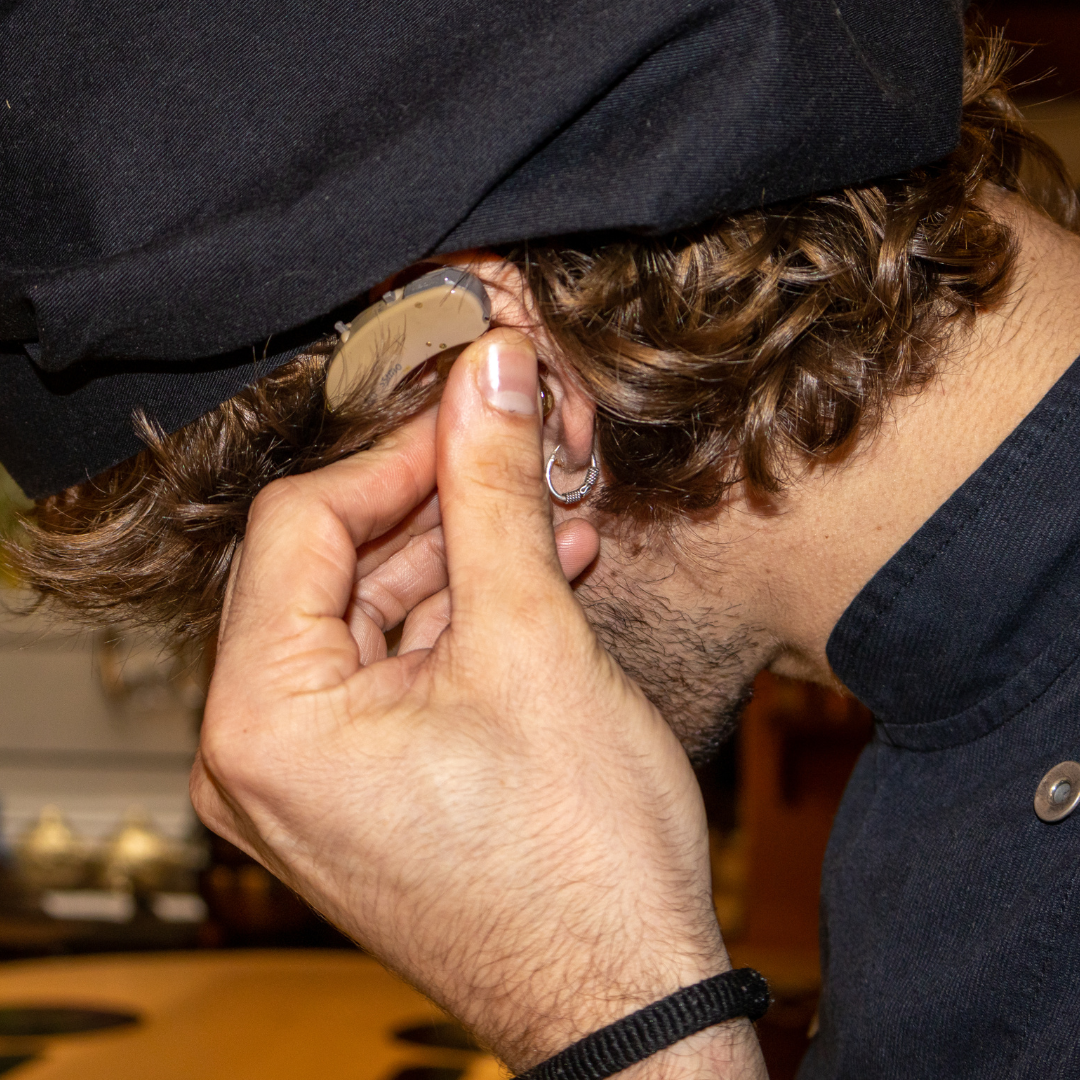
Maintaining dinner dialogue proves demanding when chaotic ambient noise strains your concentration and hearing. We perform comprehensive diagnostic assessments to evaluate hearing in quiet rooms and challenging acoustic spaces to identify functional deficits. As soon as we identify the physiological cause of your difficult hearing, we deliver personalized rehabilitation options.
Why Do I Hear Well in Quiet but Struggle in Restaurants?
A tranquil environment produces a beneficial signal-to-noise ratio where spoken dialogue easily overpowers weak ambient noise. Busy dining establishments generate the exact reverse scenario. Multiple voices, music, kitchen noise, and reverberation overlap with speech, forcing the ears and brain to work harder to separate the person you want to hear.
Such listening challenges typically stem from high-frequency hearing loss, auditory-processing deficits, or accumulated noise-induced trauma. Attention, fatigue, dim lighting, and distance from the speaker may make it worse. Numerous individuals show standard hearing thresholds on paper but reveal marked comprehension drops on clinical speech-in-noise testing. Disproportionate difficulty in restaurants justifies professional clinical assessment even if your everyday home hearing appears intact.
How Is High-Frequency Hearing Loss Diagnosed?
Diagnostic assessment begins by documenting specific listening breakdowns, recreational noise exposure, tinnitus symptoms, medications, and hereditary auditory patterns.
Diagnostic pure-tone audiometry establishes the softest auditory thresholds you can perceive across standardized frequencies via air and bone conduction pathways. A clinical presentation of high-frequency loss produces a downward-sloping audiogram where auditory thresholds worsen significantly at higher frequencies. Diagnostic evaluations may also integrate acoustic tympanometry to check middle-ear pressure alongside word-recognition testing to evaluate speech processing.
Because a quiet booth does not recreate a busy dining room, speech-in-noise testing can add valuable information. This diagnostic protocol measures your capacity to understand target words or sentences against progressively louder multi-talker babble. Together, these results show whether the problem involves audibility, speech clarity, background-noise processing, or a combination of factors.
How Do Auditory Processing Disorders Affect Hearing in Adults?
A diagnosed auditory processing disorder affects how the brain’s auditory cortex analyzes, organizes, and interprets sound. The ears may detect tones at expected levels, but the brain may have difficulty organizing competing signals, distinguishing similar speech sounds, or following rapid conversation. We prioritize assessing peripheral auditory acuity before recommending an in-depth central auditory-processing assessment or external medical referrals.
Effective Techniques to Hear Better in Noisy Surroundings
Minor environmental adjustments can boost speech acoustic signals and supply critical visual lip-reading cues. Prior to dining, choose venues known for lower noise levels or schedule meals during quieter dining hours. Dining locations utilizing sound-absorbing elements like booths, felt panels, window curtains, and carpet offer better acoustics than high-ceilinged rooms with hard surfaces.
While seated at the restaurant:
- Reserve a table located well away from kitchen doors, active bar counters, overhead speakers, and banquet groups.
- Sit with your back near a wall to reduce noise coming from behind you.
- Face your conversation partners in good lighting.
- Keep conversational proximity as close as comfortably feasible to preserve acoustic signal strength.
- Angle your stronger-hearing ear toward the primary individual you wish to converse with.
- Ask the speaker to rephrase the missed portion instead of repeating everything.
- Actively confirm key information rather than smiling and guessing at ambiguous dialogue.
- Step into a quiet area for a few minutes when listening fatigue begins to compromise focus.
- Request that dining partners articulate words distinctly at an unhurried, natural speed.
- Speaking with excessive volume creates acoustic distortion that fails to make words clearer.
Modern Audiological Tools for Managing Background Noise
The best technology depends on the cause of the difficulty, the listening environment, and whether hearing loss is present. Customized hearing aids employ directional microphone beamforming, noise cancellation algorithms, and targeted dining programs to prioritize speakers in front while lowering ambient noise. Maintaining realistic expectations remains essential, as no auditory device can isolate conversation by removing all surrounding voices.
Incorporating a dedicated remote microphone provides an even more pronounced improvement in signal-to-noise ratio. The accessory is worn on the lapel or set near the speaker, streaming their voice directly into compatible hearing aids or wireless audio receivers. This reduces the effects of distance and surrounding noise.
Other useful options include:
- Omnidirectional table microphones designed for group dining tables
- Telecoil components connecting directly to public hearing-loop systems
- Smartphone live-captioning platforms providing instant speech-to-text visual support
- Earbuds or hearables with compatible assistive-listening features
- Decibel-monitoring apps and crowd-sourced dining platforms that track restaurant noise
Our team can compare these systems, verify device compatibility with your hearing aids, and provide comprehensive training on their use.
How Can a Doctor Help with Hearing in Loud Places?
A hearing evaluation can move the conversation beyond “I hear fine in quiet.” Our clinicians review the specific environments, vocal pitches, and decibel levels that trigger breakdowns to design a personalized test protocol. The assessment may include pure-tone thresholds, middle-ear testing, word recognition, and speech-in-noise measures. Dedicated central auditory-processing testing will be scheduled if your history and primary diagnostic testing indicate central pathway issues.
Rapidly progressing, asymmetrical, or sudden hearing decline warrants an urgent clinical referral to an ear, nose, and throat physician. Dedicated individualized care pinpoints the underlying auditory cause rather than dismissing your struggles as standard restaurant noise.
Book Your Comprehensive Hearing Evaluation Now
If restaurant conversations leave you guessing, withdrawing, or feeling exhausted, schedule a comprehensive hearing evaluation with us. Our clinical team will determine the best strategies to improve your hearing in noisy environments through custom hearing-aid programming, remote microphones, or targeted auditory rehabilitation.
Get in touch with our team to request an appointment and rediscover confident, stress-free restaurant conversations.